
IDOC Intake from Richland
The Richland County Sheriff's sentencing guidance identifies IDOC as the initial IDOC destination for adult men committed from the county jail. This is a transfer between custodians, not a community release. The county transaction should identify when Richland custody ended and which agency received the person. After intake, the statewide IDOC profile is the primary source for location, sentence, institutional release, and discharge.
IDOC is an intake route, not a promise of long-term placement. IDOC may classify and move someone later. An older IDOC location can be accurate history while the current record names another prison, a work-release center, a parole district, or a discharged status. Save the access date with every result.
Confirm a IDOC Release
Use the official IDOC search by last name, IDOC number, or birthdate. Compare full name, date of birth, and IDOC number before selecting a match. Read Offender Status and Location together, distinguish a projected date from an actual Parole Date, and review every sentence row.
- Confirm identity with more than a name.
- Record current status and location.
- Separate Projected Parole Date from actual Parole Date.
- Check all counts for Sentence Discharged values.
- Recheck for a later warrant, revocation, or return.
PAROLE, a parole-district location, and an actual date support release from prison to supervision. They do not prove final discharge. The date guide explains those fields, and the Richland release hub connects the county transfer with state records.
IDOC Records and Contacts
Illinois Department of Corrections
Public search help: 217-558-2200
Public Information Office, 1301 Concordia Court, P.O. Box 19277, Springfield, IL 62794-9277
Give an IDOC number when known, former facility, conviction county, year received, and relevant dates. The IDOC contact page provides the current electronic route. County and state records are separate. Richland Corrections, 211 W. Market Street, Olney, 618-395-7483, jail@richlandcounty.illinois.gov, holds the earlier booking and transfer transaction.
The Richland court chronology is available through Judici court code IL080015J. A mittimus is the court's commitment document. It can explain why IDOC received someone, but it is not the executed transport record.
IDOC Dates and Discharge
Projected Parole Date estimates institutional release to parole or mandatory supervised release. Projected Discharge Date estimates the later end of the full IDOC obligation. Both can change after sentence corrections, credit awards or loss, consecutive terms, absence, violation, or another order. Neither is a promised IDOC exit.
An actual Parole Date with current PAROLE status documents the earlier event. Final discharge needs the complete current profile and every sentence row, or a relevant Prisoner Review Board early-final-discharge decision. One “Sentence Discharged: YES” row does not establish that all sentences ended.
IDOC Supervision After Release
IDOC's Parole Division supervises parole and MSR. The separate Illinois Prisoner Review Board sets conditions, handles applicable old-law parole decisions, and decides violations. Most modern determinate cases do not depend on a discretionary parole vote. Sentence law supplies the institutional date while PRB sets conditions.
Pair current IDOC status with PRB revocation results when later events matter. A prior release remains true history even if a later warrant or revocation returns someone to custody. The IDOC Wanted Fugitives page is a current-status channel, not proof the original release never occurred.
IDOC Search Scope Limits
The Richland sheriff list covers current county custody. It cannot verify IDOC placement, a later IDOC move, or state discharge. VINELink may provide participating-agency events, but it is not the permanent IDOC archive. BOP and ICE cover different federal populations.
A no-result can reflect spelling, alias, processing delay, an older record, or the wrong system. Compare the mittimus, Richland transfer record, and IDOC profile. If public sources conflict, request written IDOC verification rather than interpreting disappearance as release.
IDOC Profile Field Reading
An IDOC profile must be read as a set. The IDOC number, name, birthdate, parent institution, Offender Status, Location, physical profile, Admission Date, parole dates, discharge estimate, and sentence rows answer different questions. Confirm identity before interpreting status. A partial surname is useful for variants, but it also returns more people.
Sentence rows can include the case or mittimus, offense, class and count, custody date, term, conviction county, and whether that sentence is discharged. Review every row. One YES does not establish that all state terms ended. Compare case details with the Richland judgment and request the official clerk record if the abbreviated online chronology is unclear.
The parent institution is not always the present physical location. Location may instead identify another facility or a parole district. Save the access date because transfers and status changes can make an older screenshot accurate history but an inaccurate current description.
When a search is blank, record the exact inputs and access date. Report only that no matching public result appeared. An alias, intake delay, old record, correction, or wrong custody system may explain the gap. Confirm the receiving agency with Richland Corrections and request IDOC verification before calling the person released.
IDOC Credit Calculation Boundaries
Illinois credit rates depend on the offense and governing date. Some murder and terrorism categories serve 100 percent. Listed violent offenses generally have credit capped at 4.5 days per sentence month, often summarized as about 85 percent served. Listed serious drug offenses may receive at most 7.5 days per month, about 75 percent. Other eligible determinate terms may receive one day for each day served.
Percentages are not a safe release calculator. Program and education awards, discretionary Director credit, pretrial custody, disciplinary loss or restoration, consecutive or concurrent structure, absence, new sentences, and court corrections affect the official result. Some credit categories also have statutory floors. IDOC staff calculate and review projected and mandatory dates.
The profile's Projected Parole Date estimates release from prison to parole or MSR. Projected Discharge Date estimates the later end of the overall state obligation. Actual Parole Date plus current PAROLE status supports the first event. Final discharge requires the full current record and all sentence rows.
IDOC Parole and PRB Roles
IDOC's Parole Division supervises parole and mandatory supervised release. The Illinois Prisoner Review Board is separate. It sets conditions, decides applicable old-law indeterminate or youthful parole matters, handles revocation, and can consider early final discharge. These agencies answer related but different questions.
Most modern determinate sentences do not depend on a discretionary parole grant. Sentence law supplies institutional release after lawful credits, and PRB sets conditions. Old-law and certain youthful cases can involve a vote. That distinction explains why a person may properly reach MSR without appearing in a universal name-search parole decision list.
Use current IDOC status with PRB revocation results when later events matter. A person can validly leave prison, later become wanted, and return after revocation. Report the chronology rather than rewriting the original release. The IDOC Wanted Fugitives page supplies a separate current statewide absconder channel.
IDOC Records Request Route
For search assistance, call IDOC at 217-558-2200. For written verification, contact the Public Information Office at 1301 Concordia Court, P.O. Box 19277, Springfield, Illinois 62794-9277, or use the official contact page. Provide the IDOC number, full name, birthdate, conviction county, year received, known institutions, and date range.
Ask for existing admission, location history, sentence-calculation, actual parole/MSR, projected discharge, final discharge, and releasable transfer entries. A narrow electronic-record request is easier to identify than a demand for every file. It also allows the agency to redact a protected portion while releasing the rest and explaining any denial basis.
County and state requests are separate. Richland Corrections holds the county booking and transfer transaction. The Circuit Clerk holds the judgment. IDOC holds the state reception, placement, sentence administration, institutional release, and discharge record. Together they establish the custody chain without assigning one office facts it does not maintain.
IDOC Event Wording
Preserve the milestone named by the source. County transfer, IDOC institutional release to MSR, and final state discharge are not synonyms. Cite the Richland transaction, actual IDOC Parole Date and status, or complete discharge record as appropriate. Precise wording makes the result useful without overstating what one field or one agency can prove, especially when later revocation changes current custody.
IDOC Official Source Views
The official IDOC legacy search form shows the accepted lookup inputs.
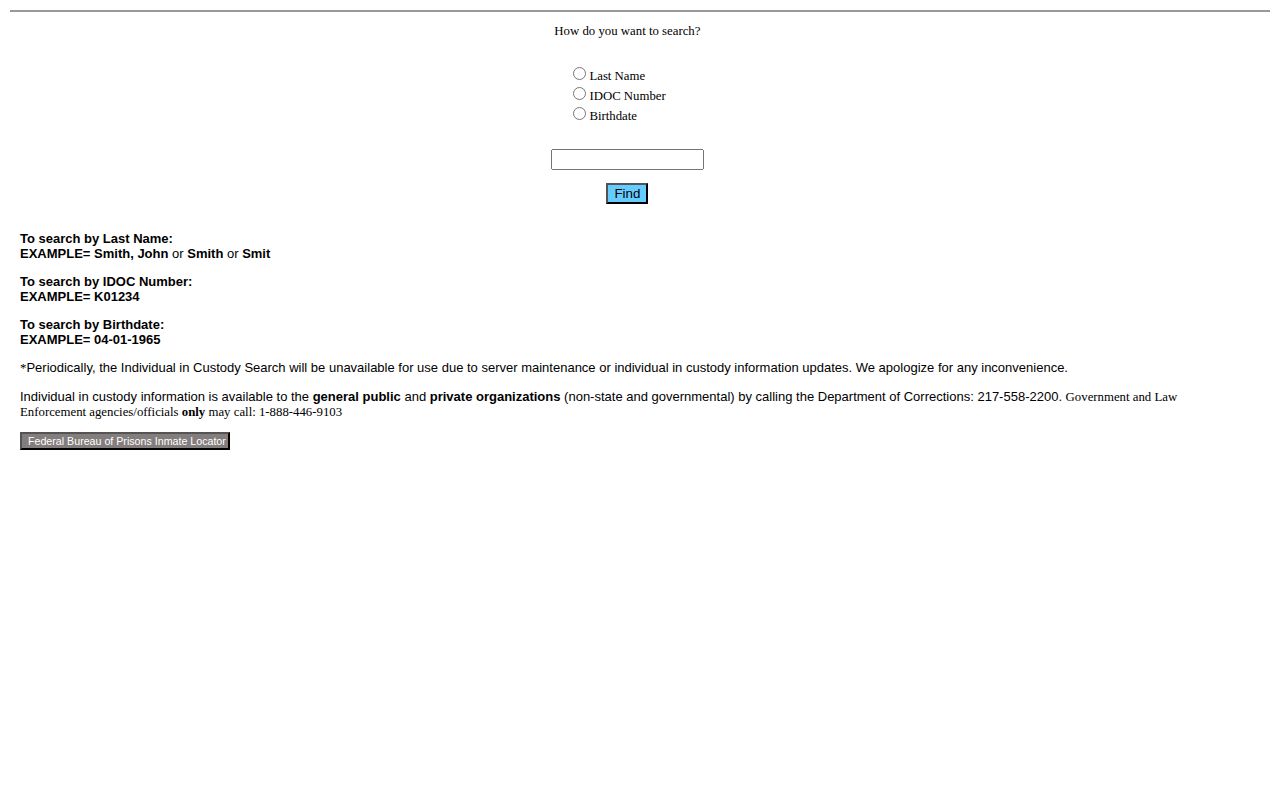
The form view reinforces that last name, birthdate, and IDOC number are distinct search routes.
Illinois sentence credits come from 730 ILCS 5/3-6-3, not a generic calculator.
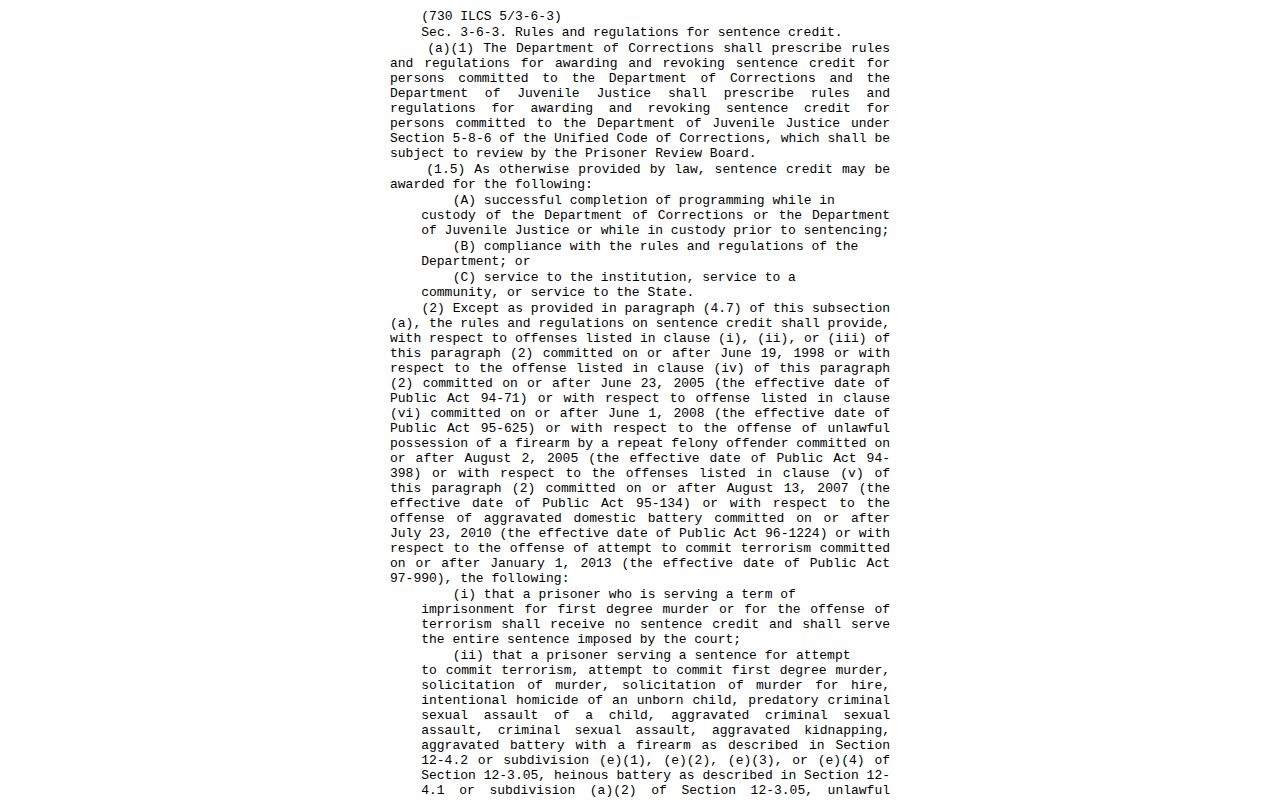
The statute view provides context for why offense and date facts must precede any estimate.
The IDOC Wanted Fugitives page is the separate statewide absconder channel.
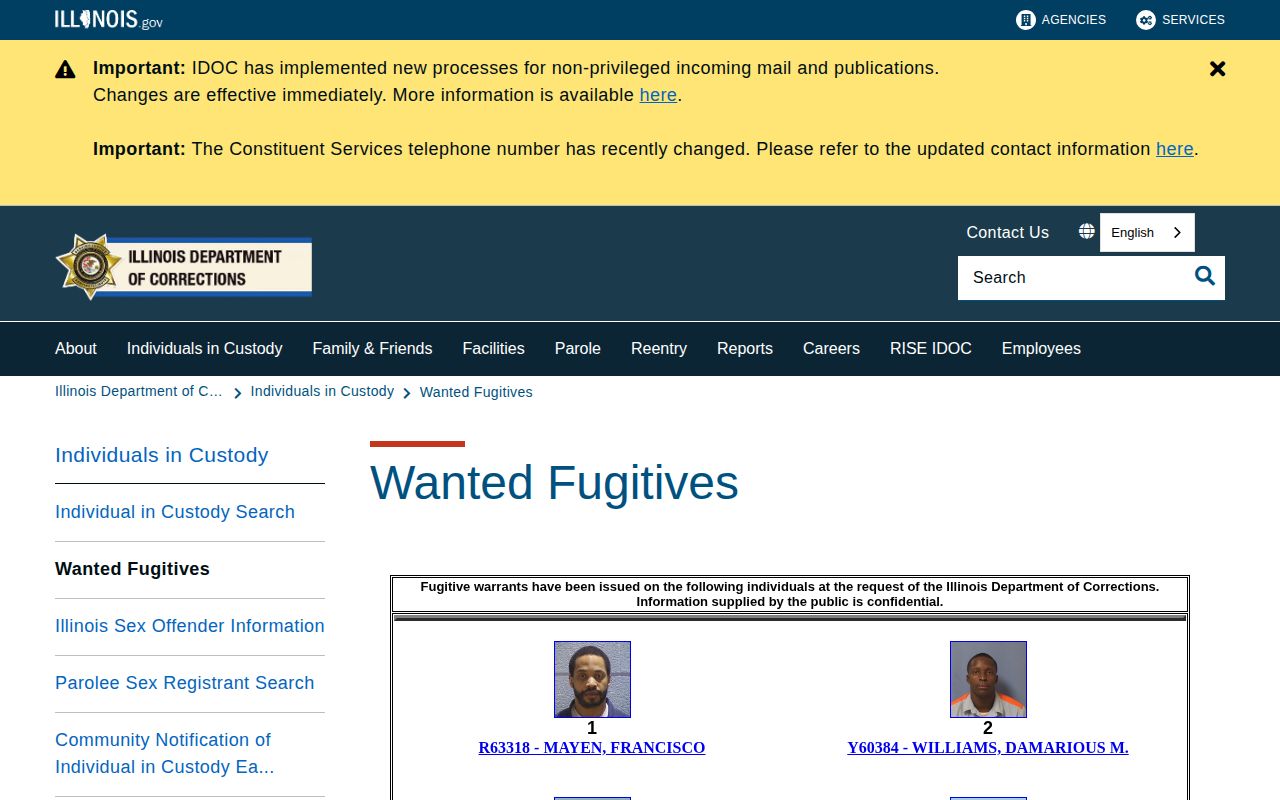
Its separation from the main profile helps preserve the timeline between a prior release and later wanted status.